
Fractional CFO
Fractional CFO vs Full-Time CFO: What Makes Sense for Growth-Stage Companies?
A direct comparison on cost, capability, and fit — for companies navigating the decision between a part-time finance leader and a full-time executive hire.
John Regan, CPA | 10 min read

The Question That Comes Up Every Time
Once you know you need CFO-level support, the next question is always the same: do I hire someone full-time, or go fractional?
I've been answering this question for over 15 years. For most founders in the $1M–$30M range, the answer is clear — and it isn't close.
But the reasoning matters. Here's exactly how I think through it.
The Real Cost of a Full-Time CFO
Start with cost, because this is where the math matters most. The salary you see in the job posting isn't the number you should be using.
When you factor in equity, benefits, payroll taxes, and recruiting — the gap is $250,000–$400,000 per year. Founders anchored on base salary miss this. Don't make that mistake.
Can a Fractional CFO Actually Do the Job?
Fewer hours doesn't mean something falls through the cracks — if it's scoped right. Monthly reporting, cash management, board prep, fundraise support: none of that requires 40 hours a week. It requires a senior executive focused on the right deliverables.
The model works when you have an operational layer underneath (a controller or senior bookkeeper) and priorities can be sequenced. It's under strain when you're mid-ERP implementation, managing a large finance team daily, or pre-IPO with near-constant investor demands.
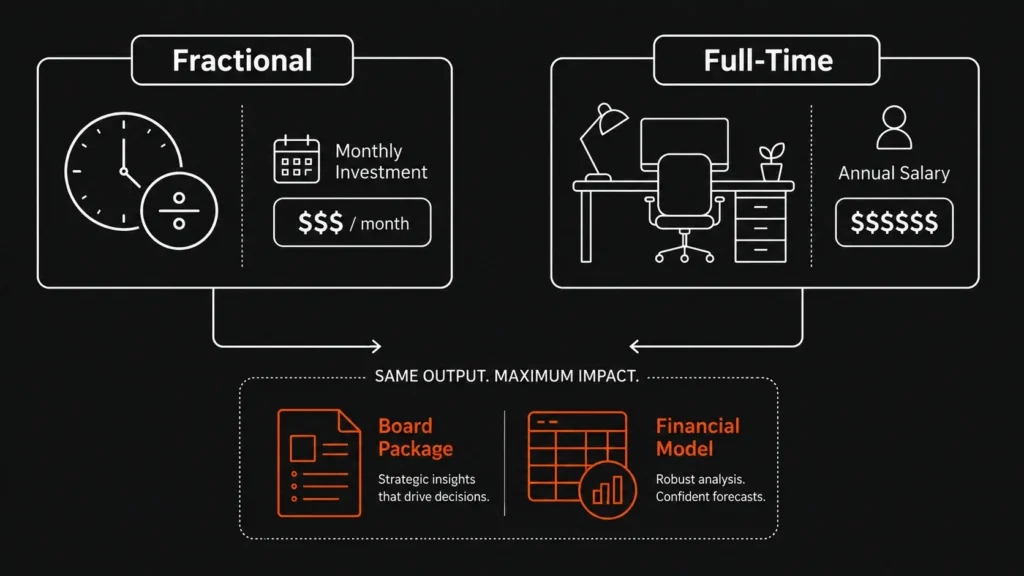
The Full Side-by-Side
| Factor | Fractional CFO | Full-Time CFO |
|---|---|---|
| Annual cost (fully loaded) | $60K–$150K | $340K–$500K+ |
| Equity dilution | None | 0.5%–1.5% typical |
| Time to operational | 30–60 days | 90–180 days (recruiting + ramp) |
| Hours per week | 4–20 hours depending on scope | 40–60 hours |
| Industry depth | High (specialist firms) or variable (independent) | Depends on candidate; high variability |
| Scope flexibility | Adjustable monthly based on need | Fixed commitment; difficult to adjust |
| Board/investor reporting | Yes | Yes |
| Financial modeling | Yes | Yes |
| Fundraise support | Yes | Yes |
| Daily operational presence | Limited by design | Yes |
| Team management (large team) | Better suited with smaller finance team | Yes |
| Best stage fit | $3M–$40M revenue | $30M+ revenue, or pre-IPO |
I worked with a digital health company at $14M ARR that was stuck between two options: hire a full-time CFO at $280K base or bring in a fractional team. They'd already spent four months on the full-time search and had one failed offer. We were operational in three weeks.
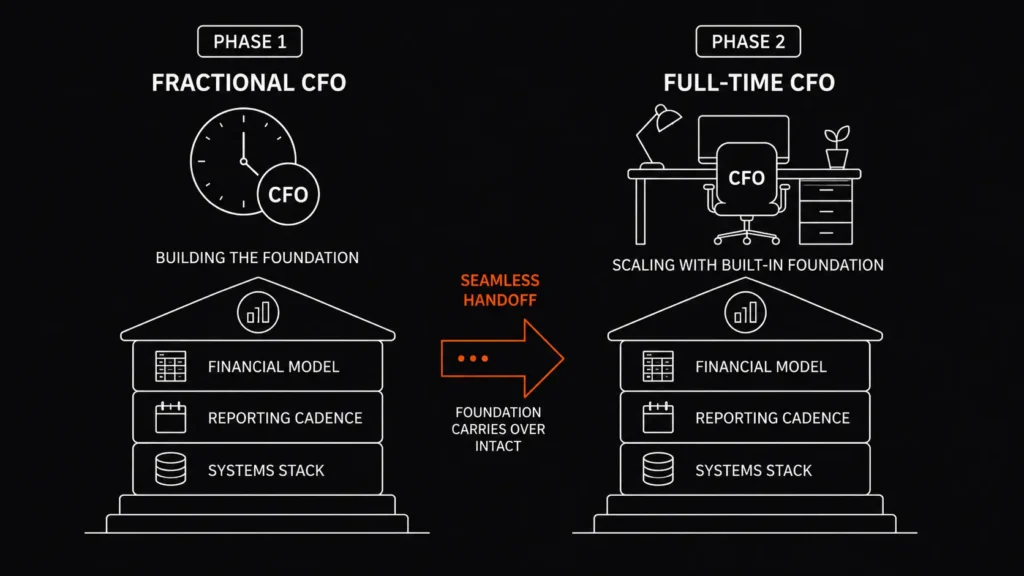
Over the next eighteen months, we built the three-statement model, ran the Series B data room, managed the audit, and set up their board reporting cadence. The Series B closed. Then they hired a full-time CFO — and we handed everything off over a clean sixty-day transition. Documentation, systems, model, all of it ready to go.
Total cost of the fractional engagement over eighteen months: approximately $180K. Right tool. Right stage.
When a Full-Time Hire Is the Right Call
- You’ve crossed $30M–$40M with a finance team of three or more. You need someone in the seat daily.
- You’re 12–18 months from an IPO. S-1 drafting, SOX, SEC registration — that’s a full-time job with public company experience.
- You’re in a live M&A process. Near-daily availability across time zones. That’s a full-time commitment.
- Your investors require it. Some institutional leads make it a condition. Deal with it directly.
How the Transition Works
Going fractional now doesn't lock you in. We build the infrastructure, establish the reporting cadence, and document the systems. When you're ready for a full-time hire, they walk into something functional — not a blank page. That's a better situation than writing a job description for a role you've never had.
"I've closed Series Bs, run audits, and built board-ready models — all fractional. This isn't a budget compromise. It's the right structure for where you are."
Explore Adea's Finance Services
Frequently Asked Questions
Is a fractional CFO as effective as a full-time CFO?
At the $1M–$30M stage, yes — if scoped correctly. I've built investor models, run data rooms, managed audits, and set up board reporting on a fractional basis. The outputs are the same. It breaks down only when you need daily operational presence, a large finance team managed full-time, or IPO/M&A availability. Outside those situations, fractional wins.
What's the actual cost difference?
Fractional: $60K–$150K per year. Full-time fully loaded (salary, equity, benefits, taxes, recruiting): $340K–$500K+. The gap is $250K–$400K annually — before you count the recruiting time and the 3–6 month ramp. The math isn't close.
Can a fractional CFO lead a fundraise?
Yes — it's one of the highest-leverage things we do. I build or sharpen the model, organize the data room, prepare projections, and manage diligence responses. Engage us six months before your target close, not after you're already in conversations.
When should I make the transition to a full-time CFO?
When you hit $30M–$40M with a finance team that needs daily management, or 12–18 months from an IPO, or in an active M&A process. Plan the transition 60–90 days out — don't make it reactive. The best handoffs I've run were fully documented before the new CFO walked in.