
Fractional CFO
How to Hire a Fractional CFO Without Slowing Down Your Business
What to look for, what to avoid, what questions to ask, and what the first ninety days of a well-run engagement should produce.
John Regan, CPA | 7 min read

The Honest Answer
I get this question on almost every first call. Founders either expect too much — thinking I'm going to run their whole finance function — or too little, assuming it's basically an upgrade from their bookkeeper.
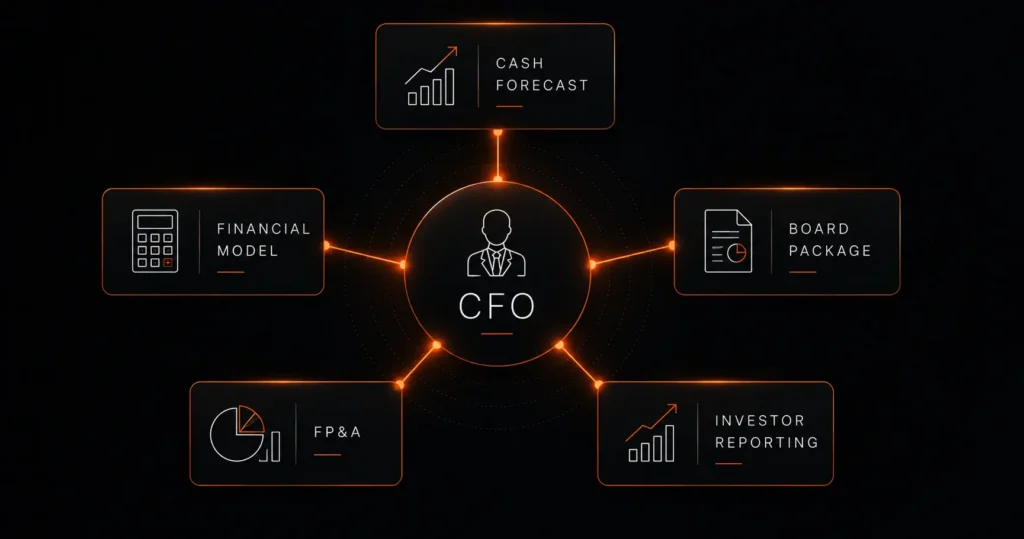
Here's the direct answer: a fractional CFO thinks about the financial future of your company. Your bookkeeper records what happened. Your controller closes the period. I ask what happens next, and what you need to do about it right now. My work falls across four areas: financial planning and analysis, cash and capital management, investor and board relations, and financial systems and controls.
Financial Planning and Analysis (FP&A)
This is the core of what I do. FP&A means building and maintaining a financial model that links your revenue assumptions, cost drivers, headcount plans, and capital needs into a single, connected picture of where the business is going.
A good model isn't a static deck from your last raise. It gets updated when actuals come in, stress-tested when assumptions change. When you ask "what happens to our runway if we miss Q3 by 15%?" — I can answer that in thirty minutes. Most $5M–$15M companies I walk into don't have this. They have a revenue tab that hasn't been touched since the last fundraise. That's not a model. That's a guess.
Cash and Capital Management
Revenue and cash are not the same number. I've seen companies with $12M in annual revenue run out of cash. It's more common than founders expect — and it's almost always preventable. The $1M–$30M stage is the most exposed window: large enough to have complex payment cycles, not yet large enough to have anyone watching them closely. I build and maintain a 13-week rolling cash forecast — a live view of actual positions against expected inflows and outflows. That's what lets you hire, pause, bridge, or negotiate from clarity instead of panic.
Capital structure is CFO territory too. When to raise debt vs. equity. How to think about a credit facility. Whether an SBIR grant is worth the time. How to structure a bridge without giving away more than you should. These decisions have long tails. You want a CFO in that room.
I worked with a consumer goods company doing $18M in revenue. They'd had three straight months of tighter-than-expected cash balances, even as revenue grew. Nobody could explain it.
The problem: their largest retail partner paid on 60-day terms, and their manufacturer required payment in 90 days. A structural cash wedge — baked into their operating model — that nobody had ever modeled out.
We restructured the payment cycle, negotiated a revolving credit facility, and built a weekly cash dashboard. Problem solved in sixty days. The issue wasn't performance. It was visibility. Nobody had been looking.
Investor and Board Relations
Once you have institutional investors — or you're actively trying to get them — the quality of your financial communication is a competitive variable. Investors who are well-informed move faster. Investors who have to chase information develop concerns that don't go away.
I own the finance side of that relationship. Board packages go out 48 hours before the meeting — management accounts, KPI dashboards, variance commentary, forward outlook. I take investor finance questions directly, not bounce them back to you. During a fundraise, I lead financial diligence: building the investor-ready model, organizing the data room, running diligence responses, and sitting in on any term sheet conversation that touches a financial representation. The preparation going in is everything.
Financial Systems and Controls
The systems that got you to $5M won't get you to $20M. Accounting software that worked at $2M starts creating reconciliation problems at $10M. A spreadsheet-based expense process that was fine with five people is a control risk at thirty. Part of my job is evaluating and cleaning up the underlying infrastructure — the accounting stack, the month-end close, the expense workflow, the revenue recognition policy, the chart of accounts. Investors doing diligence notice systems quality immediately. I've watched deals slow down because the finance function looked like it was held together with duct tape. Don't let that be you.
What a Fractional CFO Is Not
- Not your bookkeeper. I don’t record transactions, reconcile bank accounts, or manage AP. You need a bookkeeper for that — and you should have one. That’s their job, not mine.
- Not your tax CPA. Tax compliance sits with your external CPA firm. I coordinate with them. I don’t do the compliance work.
- Not your controller. Your controller owns the close and the accounting operations. I sit above that function and use their output as the input for strategy, modeling, and reporting.
- Not a placement agent. I support your fundraise from the finance side — the model, the data room, the diligence responses. I’m not a broker or intermediary for capital. That’s a different function entirely.
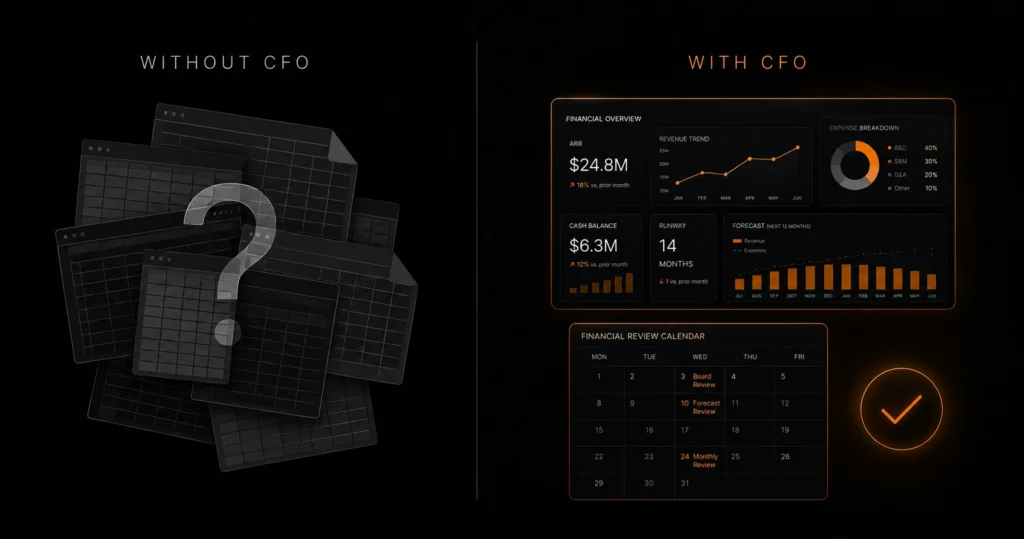
With and Without a Fractional CFO
| Moment | Without a Fractional CFO | With a Fractional CFO |
|---|---|---|
| Investor asks for a model | Founder builds something overnight; model has no cash flow tab; investor raises concerns | Three statement model is ready; assumptions are documented; diligence moves forward |
| Board meeting | Package assembled the morning of; no variance commentary; board asks questions that weren't anticipated | Package sent 48 hours prior; commentary explains the numbers; meeting stays on agenda |
| Cash gets tight | Founder notices at month end; no forward visibility; decisions made reactively | 13 week forecast flagged the constraint four weeks ago; contingency options were already evaluated |
| Audit or financial review | Auditors request documents the company doesn't have organized; timeline slips; findings are discovered late | CFO has managed the process; documents are prepared; findings are addressed before the final report |
| New hire decision | Founder decides based on need; no financial model of impact on runway or profitability | CFO has modeled the hire against budget; timing is financially optimized |
"I'm not here to explain last month's numbers. I'm here to make sure you know what to do about next quarter before it starts."
Explore Adea's Finance Services
Frequently Asked Questions
What is the primary role of a fractional CFO?
Strategic financial leadership on a part-time basis — FP&A, cash management, investor reporting, and finance function oversight. It's not accounting or compliance. It's the forward-looking work that tells you where the business is going and what to do about it.
Does a fractional CFO do bookkeeping or accounting?
No. I work at the strategic layer — using the output of your bookkeeper and controller to drive modeling, reporting, and decisions. If your books aren't being maintained by someone qualified, that's the first thing we fix. But it's not my function.
How many hours per week does a fractional CFO typically work?
In a steady operating state, most companies need roughly 8 to 10 hours per month. During a fundraise or audit cycle, that goes up. I scope engagements around your actual needs, not a fixed retainer that doesn't flex.
Can a fractional CFO help with fundraising?
Yes — and this is often where an engagement earns back its entire fee. I lead the financial side of the raise: investor-ready model, data room, diligence responses, and any term sheet conversation that touches a financial representation. Investors move faster when the finance function is solid.