
Fractional CFO
Is a Fractional CFO Right for Your Company? Signs You've Outgrown Basic Accounting
The signals are usually there before founders notice them. Revenue is growing. The books are technically done. But the questions that matter — runway, margins, what investors will see — nobody can answer.
John Regan, CPA | 7 min read
What Is a Fractional CFO?
A fractional CFO is a senior finance executive who works with your company part-time — a few days a week or a few days a month — instead of as a full-time hire. You get CFO-level thinking, financial systems, and investor-facing capability without the $300,000–$450,000 fully loaded cost. For companies in the $1M–$30M range, that's usually the right trade.
I'm not a bookkeeper, not a tax CPA, not a controller. I operate at the strategic layer — financial planning, investor readiness, cash visibility, board-level reporting. The founders who call me aren't struggling with recordkeeping. They're struggling with what the records mean — and what to do about it.
Seven Signs You've Outgrown Basic Accounting
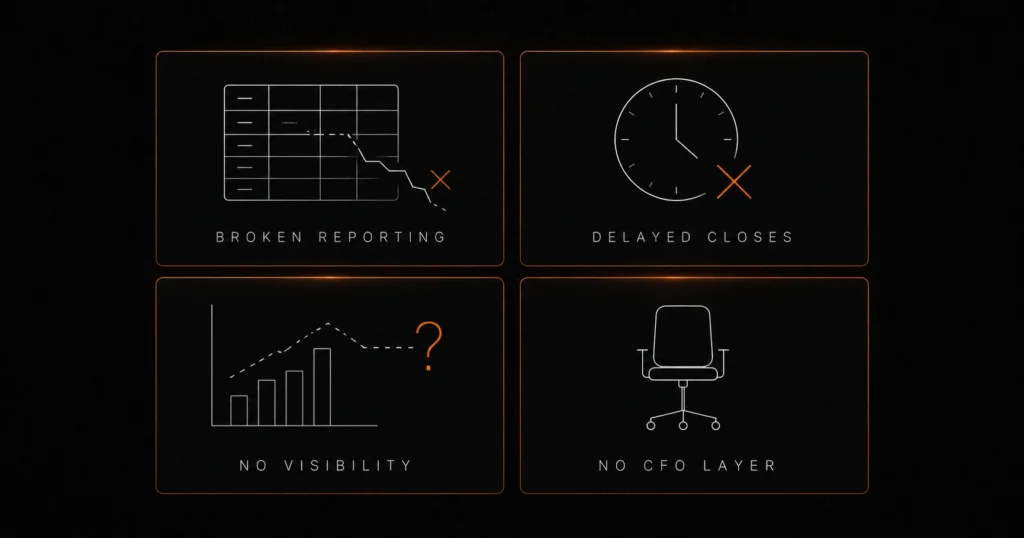
Most founders don't decide they need a CFO — they discover it when a high-stakes question gets a bad answer. Here are the seven signals I look for:
- You can’t answer the runway question cold. If it takes you more than thirty seconds to say how many months of cash you have, you don’t have real financial visibility. That’s not a bookkeeping problem. That’s a CFO problem.
- Your close takes longer than ten business days. We close books in five to seven. Beyond ten, you’re making decisions on stale data — and you probably don’t know what you don’t know.
- You’re heading into a fundraise. Investors will ask for a three-statement model, a data room, audited or reviewed financials, and a clean cap table. Your bookkeeper can’t build any of that. I can.
- Your board is asking financial questions you can’t answer cleanly. The moment your board includes someone who knows what good reporting looks like, your reporting gets evaluated. No variance commentary, no forward forecast, no KPI tracking — that’s a credibility problem, not just a formatting problem.
- You don’t know your gross margin to the decimal. “Somewhere around 40–50%” is not a number. If you need a conversation to arrive at it, your cost accounting isn’t set up right.
- You’re in a regulated industry. MedTech, pharma, CPG, food and beverage — these industries carry compliance obligations a bookkeeper isn’t equipped to manage. GAAP requirements, FDA cost tracking, 409A valuations. That’s CFO territory.
- Revenue has crossed $5M and is still climbing. Below $5M, a solid bookkeeper and a good CPA usually hold. Above it, the complexity — working capital cycles, deferred revenue, multi-channel attribution, payroll at scale — demands a different level of management.
I worked with a MedTech founder who called me after a Series A term sheet fell apart in diligence. The investor's team asked for a three-statement model and a cohort analysis of gross margin by product line. His bookkeeper had clean records — every transaction was in QuickBooks — but nobody had ever structured the data to answer those questions. We spent two months doing cleanup that should have been done in year one. Then they closed the round.
Clean books are necessary. They're not sufficient.
What You're Missing Without a CFO
The founder either doesn't know what's missing — until a high-stakes moment exposes it — or they're carrying the finance function themselves. Here's what's usually absent:
- A real financial model. Not a spreadsheet with a revenue line. A model that connects headcount, revenue assumptions, and capital needs into a coherent 12–24 month view. Most companies don’t have one.
- Cash flow forecasting. Revenue growth doesn’t solve cash flow problems — it amplifies them. I’ve watched profitable companies get blindsided by a cash crunch because nobody was forecasting weekly. It’s avoidable.
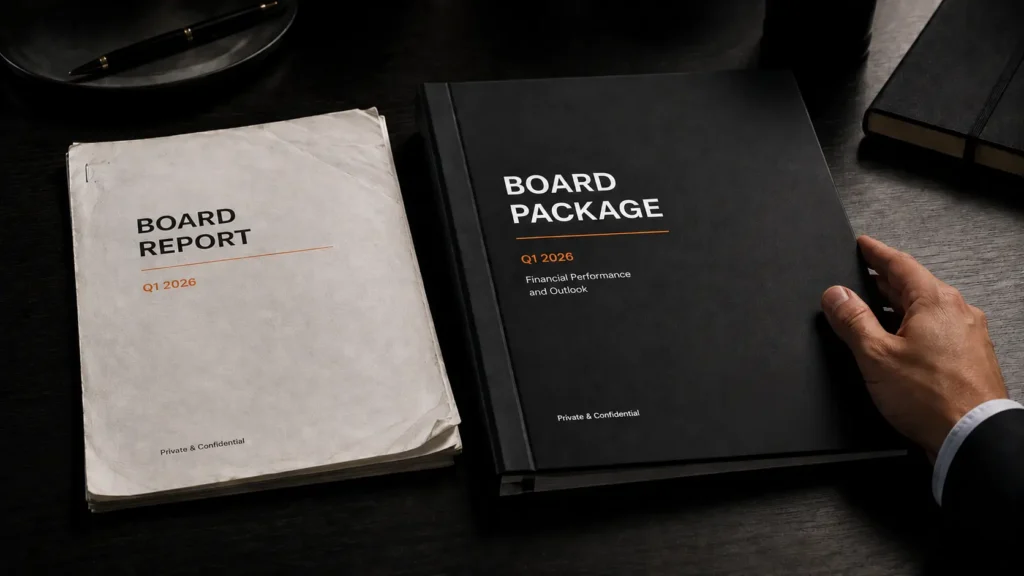
- Investor-grade reporting. Board packages and KPI dashboards that are consistent, timely, and decision-relevant. Not assembled the morning of the meeting.
- Someone to own the finance narrative. When investors or board members ask hard financial questions, you need someone whose job it is to answer them. That’s not your job as founder. It’s mine.
Who This Is For — and Who It Isn't
Fractional CFO work fits a specific window: you've outgrown your current finance function, but a full-time hire doesn't make economic sense yet. We're a fit when:
- Revenue is between $3M and $50M
- You have institutional investors, a board, or active fundraising plans
- You’ve got a bookkeeper or controller, but nobody’s doing strategic finance
- You’re personally fielding investor and board finance questions — and you’re done doing that
- A specific event — fundraise, audit, acquisition — needs CFO-level preparation now
Pre-revenue or very early stage? A good bookkeeper and CPA will hold. But don't wait too long — the gap shows up at the worst possible moment.
The Three Finance Roles: What Each One Actually Does
The most common mistake: expecting CFO-level output from a bookkeeper or controller. The roles don't overlap the way founders assume.
| Role | Primary Function | Typical Output | Strategic Finance? |
|---|---|---|---|
| Bookkeeper | Transaction recording, bank reconciliation, basic accounts payable/receivable | Clean ledger, categorized transactions | No |
| Controller | Month-end close, financial statements, compliance, payroll oversight | Accurate financial statements on schedule | Rarely |
| Fractional CFO | Financial strategy, FP&A, investor relations, cash visibility, board reporting | Model, board package, investor narrative, financial systems | Yes |
I've seen founders promote their controller into a de facto CFO role and wonder why fundraising goes sideways. It's not the controller's fault — that's not the job they were hired to do.
"In my experience, most growth-stage companies don't have a finance problem. They have a finance leadership problem. The numbers are there. Nobody's interpreting them — or doing anything about it."
The Cost of Waiting
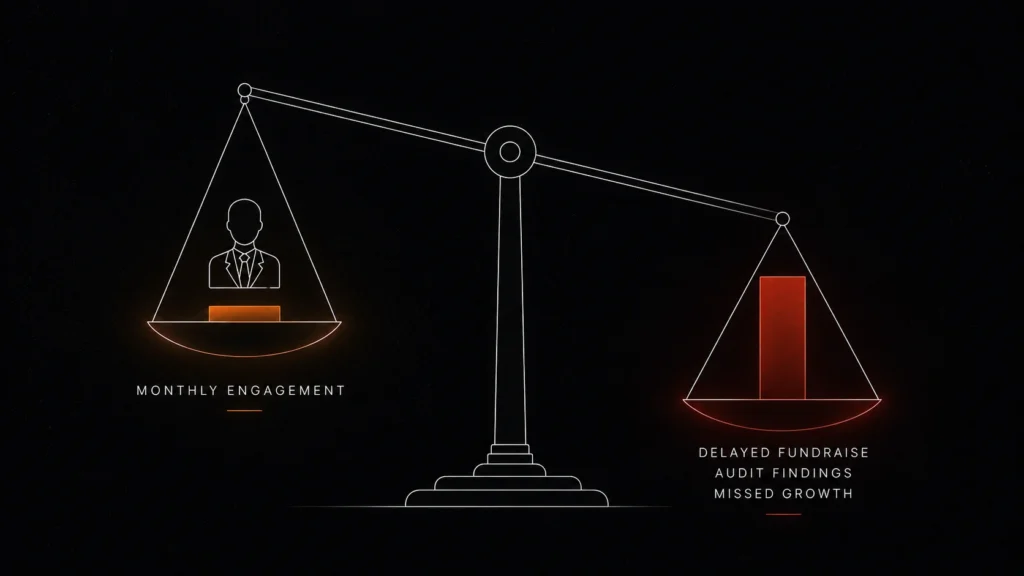
The most expensive outcome isn't hiring the wrong fractional CFO. It's waiting too long. I've seen the delay cost companies a fundraise that took six months longer than it should have, a board relationship that eroded from consistently late reporting, and a cash crisis that hit without warning because nobody was forecasting.
We engage at $5,000–$15,000 per month. That's a fraction of what those outcomes cost. If you recognize two or three of the seven signs above, the math on waiting doesn't work in your favor.
Explore Adea's Finance Services
Frequently Asked Questions
What's the difference between a fractional CFO and a full-time CFO?
Same work, different structure. A full-time CFO at a growth-stage company runs $250,000–$450,000 fully loaded. We engage at $5,000–$15,000 per month — for companies that need CFO-level capability but not a full-time seat, the math is straightforward.
When does a company need a fractional CFO instead of a bookkeeper?
A bookkeeper records transactions. A fractional CFO interprets financial data, builds forward models, and manages investor relationships. You need a fractional CFO when the questions you're being asked — by investors, your board, yourself — can't be answered by looking at last month's P&L. That usually surfaces between $3M and $10M in revenue, or earlier if you're venture-backed.
Can you work with my existing bookkeeper or controller?
That's the most common setup. The controller or bookkeeper handles the operational layer; I handle the strategic layer. Their output is the foundation I build from — it's how the function is supposed to work at your stage.
Is a fractional CFO right for an early-stage startup?
Pre-revenue or pre-seed, a good bookkeeper and CPA will hold. Post-seed with institutional investors, a board, or a fundraise on the horizon — you almost certainly need one. The moment investors start asking financial questions you can't answer cleanly, you've waited long enough.