
Fractional CFO
How to Hire a Fractional CFO Without Slowing Down Your Business
What to look for, what to avoid, what questions to ask, and what the first ninety days of a well-run engagement should produce.
John Regan, CPA | 7 min read

Most Founders Approach This the Wrong Way
A founder needs CFO help, posts a description, runs a few interviews, picks someone on gut feel. Three months later they're frustrated — the CFO is busy but nothing's changed. That's not bad luck. That's a scoping failure.
Fractional CFO engagements drift when you don't define what you need upfront. The CFO works on whatever surfaces. You never feel the value. The relationship ends without touching the actual problems you brought them in to solve. I want you to get this right the first time.
Get Clear on What You Need Before You Talk to Anyone
Don't start the search until you know what you're trying to accomplish. Your answer determines the profile you need, the hours that make sense, and how you'll measure success. Most founders hire for one of these reasons:
- Fundraise support. You have a round in the next six to twelve months and need a financial model, data room, and someone to own the diligence process.
- Board and investor reporting. Your investors expect CFO-quality reporting. You’re delivering bookkeeper-quality reporting. That gap needs to close.
- Cash visibility. Revenue is growing but cash behavior is unpredictable. You need a forecast and a system for managing it — not just a QuickBooks balance.
- Audit or financial review preparation. A lender, investor, or compliance requirement has triggered a review. You need someone to own that process.
- Financial systems overhaul. Your accounting stack and close process aren’t scalable. You need a CFO to redesign them before they break under growth.
- Ongoing CFO function. No specific event — you need CFO-level leadership on a permanent part-time basis and you’re done patching it with spreadsheets.
Each requires a different engagement profile. A fundraise CFO and an ongoing-operations CFO are not the same hire.
What to Look For in a Fractional CFO
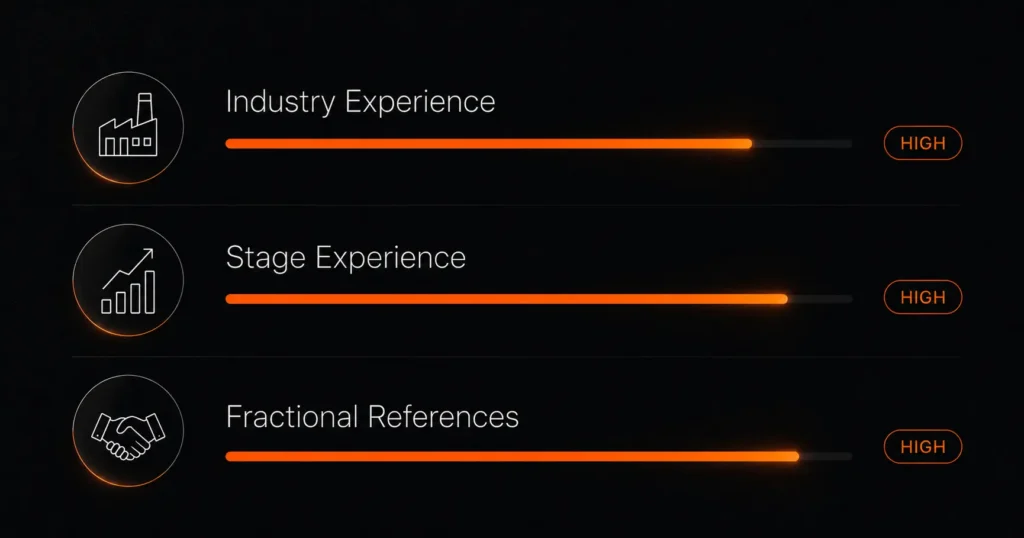
Breadth beats depth. Judgment beats credentials. The ability to operate with partial information and limited hours is non-negotiable. Here's what actually matters:
Industry experience
A CFO who knows your industry onboards in half the time. In regulated industries — MedTech, pharma, CPG — it's not optional. Compliance requirements are specific enough that generalist experience creates real gaps.
Stage experience
A Fortune 500 finance director and a CFO who built a function from scratch at a $5M company are not interchangeable. You want the latter. If they've never set up a chart of accounts or cleaned up a bookkeeper's mess, they won't be effective in your environment.
References from relevant engagements
Ask for references from fractional engagements — not full-time roles. The fractional model requires faster onboarding, narrower bandwidth, and higher independence. Past success as a full-time CFO doesn't transfer automatically.
Red Flags
Walk away from any of these:
- They can’t describe a specific first-ninety-day plan. If they’re vague about what they’d actually deliver, they haven’t done this enough. Real fractional CFOs know exactly what needs to happen and in what order.
- Too many clients. Ask directly. A CFO running fifteen concurrent engagements isn’t doing deep work for anyone. You want to know your situation has their real attention, not their calendar overflow.
- The “fractional executive” who does CFO, COO, and CMO. This profile exists. It rarely has the financial depth to lead a serious fundraise or manage an audit. You need someone whose core identity is finance — not someone who wears whatever hat the client needs that month.
- The first meeting is about them, not you. Good CFOs are diagnostic from the first conversation. They ask about your revenue model, your close process, your current reporting. If you’re forty-five minutes in and they haven’t asked about your financials, move on.
- The pitch is about being cheaper than a full-time hire. That’s the wrong frame. You’re not hiring a fractional CFO to save money on a salary. You’re adding a capability your company doesn’t currently have. Cost is part of the conversation, but it shouldn’t be the headline.
A SaaS founder hired a fractional CFO based on a resume that listed a well-known venture-backed startup. Six months in, they had clean books — but no financial model and no board-ready reporting. Nothing a Series A investor would look at.
The CFO had been an accounting manager at that startup. Not an executive. The title was accurate. The responsibility level wasn't. Nobody asked.
Ask for specifics. Check the references. Understand the role they held — not just the company they held it at.
Fractional CFO Cost and Engagement Models
Three structures dominate the market:
| Model | Structure | Typical Cost Range | Best For |
|---|---|---|---|
| Monthly Retainer | Fixed monthly fee for a defined scope, typically 8 to 20 hours per month with specific deliverables |
$5,000 – $12,000/mo |
Ongoing CFO function, board reporting, cash management |
| Project-Based | Fixed fee for a defined project, fundraise preparation, model build, audit management, systems overhaul |
$10,000 – $50,000+ |
Specific events with defined start and end |
| Hourly / Part-Time | Hourly rate with a monthly cap or hour block; more flexible scope |
$200 – $400/hr |
Supplemental support when scope is unclear or variable |
A monthly retainer creates consistent rhythm and real institutional knowledge. Project engagements work when you have a specific event — fundraise, audit, systems overhaul — with a clear finish line.
What the First 90 Days Should Produce
Every engagement I run follows the same structure. Before you sign anything, get the first ninety days in writing.
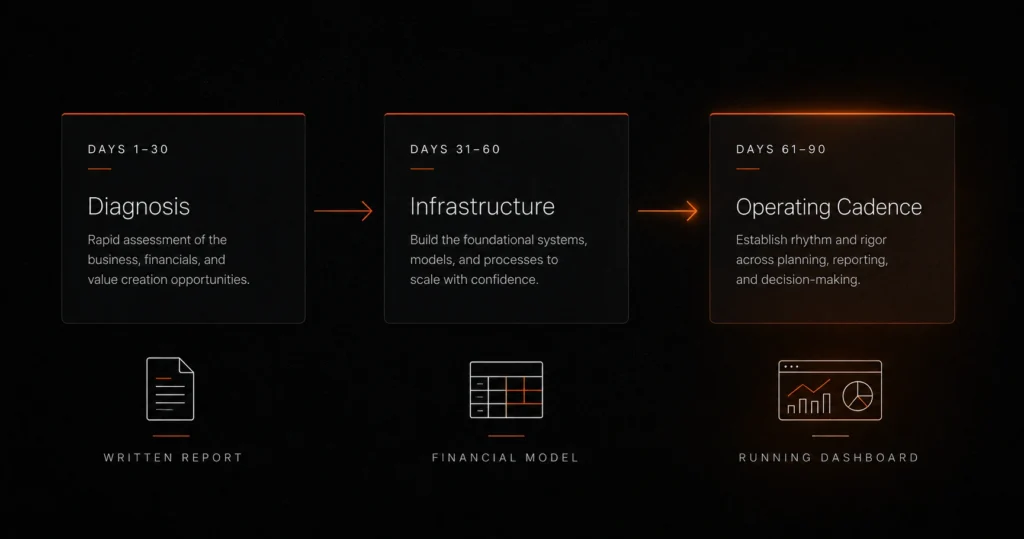
Diagnostic and Foundation
Review of existing financial statements, accounting systems, and prior reporting. Assessment of what's accurate, what's missing, and what needs to be rebuilt. First deliverable: a written diagnosis with a prioritized action plan.
Infrastructure and Reporting
Build or improve the financial model. Establish the board reporting cadence. Implement a cash forecast. Clean up chart of accounts or close process if needed. First management accounts under CFO ownership delivered.
Operating Cadence Established
Monthly close process runs on schedule. Board package delivered on the agreed cadence. Cash forecast updated weekly. Founder is no longer fielding financial questions from investors directly. The CFO function is operational.
Questions to Ask Before You Hire
Seven questions that separate real fractional CFO experience from a polished pitch:
- Walk me through what you’d do in the first thirty days. What would I actually receive?
- What’s your experience with companies at our revenue stage and in our specific industry?
- How many active clients do you have right now — and how do you protect bandwidth for each one?
- Can you show me a board package you’ve built for a company at our stage? Walk me through it.
- Have you managed a fundraise or diligence process? What was your actual role — not the company’s, yours?
- What do you need from our controller or bookkeeper to do your job well?
- What’s your process when you open the books and find something materially wrong?
"I've hired CFOs, I've been the CFO, and I've fixed the messes left by the wrong CFO. The ones who can't tell you exactly what they'll deliver in the first thirty days — I don't care how good the resume looks. They haven't done this enough."
Explore Adea's Finance Services
Frequently Asked Questions
How much does a fractional CFO cost per month?
Most retainer engagements run $5,000–$12,000 per month depending on hours, industry complexity, and whether there's active fundraise support. Project-based work — Series A prep, audit management, systems overhaul — runs $15,000–$50,000+ fixed-fee. If you can't connect the fee to a specific deliverable, the scope isn't defined yet.
What is a fractional CFO hourly rate?
Senior fractional CFOs bill $200–$400 per hour, but I'd push back on using hourly as your primary structure — it rewards time spent, not outcomes delivered. Most of my engagements are monthly retainers or fixed-fee projects. Use hourly when scope is genuinely unclear, then convert to a retainer once you know what you need.
How long does it take to onboard a fractional CFO?
Thirty to sixty days if the onboarding is structured. Month one is diagnostic — reviewing financials, finding the gaps. By month two you should have a board package, a cash forecast, and a close process running on schedule. Past sixty days and still waiting on basics? That's not an onboarding problem. That's a CFO problem.
Should I hire a fractional CFO from a firm or an independent?
Both can be excellent. The difference is redundancy: an independent CFO is a single point of failure — if they're overloaded or unavailable, your finance function pauses. A firm gives you coverage, a second set of eyes, and consistent output regardless. For ongoing needs — board reporting, investor relations, active fundraising — the firm model is more reliable. For a one-time project, a strong independent works fine.