
Cash Flow
When Should a Growing Company Bring in a Fractional CFO?
The answer is almost never "later." The specific milestones, company events, and operational signals that indicate the right time — and what typically happens when founders wait past them.
John Regan, CPA | 7 min read

The Timing Problem
Most founders call me after something breaks. A fundraise moving faster than expected. An audit finding that surfaces six months after year-end. An investor asking for a model that doesn't exist yet. By then I'm in catch-up mode — and that's not where either of us wants to start.
The right time is before the crisis. Below are the milestones, events, and signals I use to diagnose timing — and what happens when founders wait past them.
Revenue-Based Milestones
Revenue isn't a perfect trigger — but it's the right starting point. Complexity scales with revenue, and complexity drives the need for CFO-level judgment.
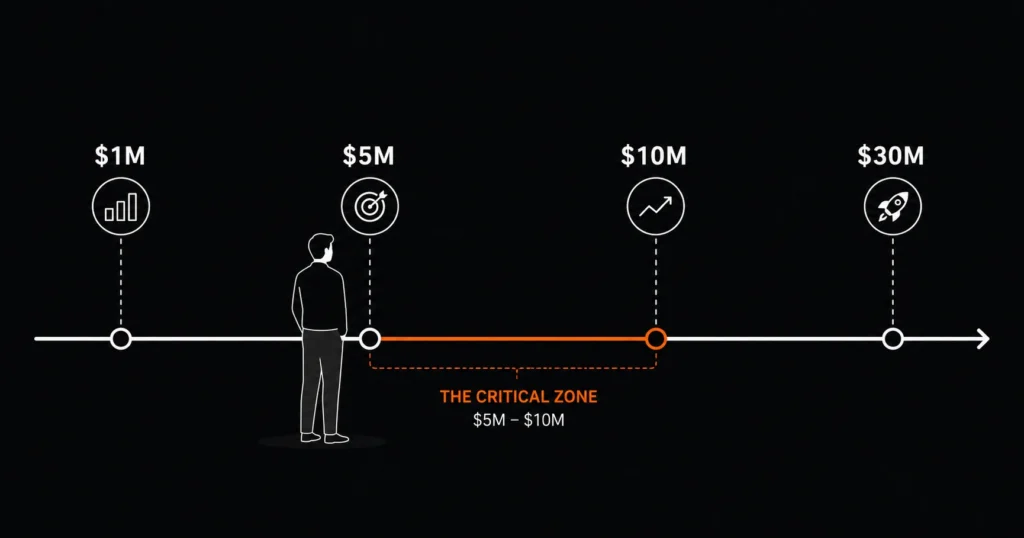
$1M–$3M: You don't need me yet — but watch the habits
A solid bookkeeper and your CPA firm can handle it. But if you already have institutional investors, don't ignore the reporting habits you're building now. I've seen companies at $10M spend six months unwinding bad accounting practices that started at $2M.
$3M–$7M: The inflection point
This is where most companies first need fractional CFO support. You've grown past the point where you can track finances intuitively. Your bookkeeper can still handle transactions — but nobody's connecting the financial picture to the strategic one. That gap is what I fill.
$7M–$30M: CFO-level work is not optional
The absence of a CFO function is a material risk. Companies in this range without one are almost always consuming founder bandwidth on finance questions, running on incomplete cash visibility, and delivering below-standard board packages. It catches up with them.
Event-Based Triggers
Some events trigger the conversation regardless of revenue. These are the moments when the cost of not having a CFO becomes most acute:
Fundraising — start 6 months before you need to close
Six months before you expect to close, you need a model, a data room, and a financial narrative that's investor-grade. Building those after a term sheet arrives is a fire drill. It makes you look unprepared and hands investors leverage they wouldn't otherwise have.
Board formation with institutional investors
Once your board includes VCs, family offices, or growth equity, your financial reporting is being evaluated at every meeting. These board members have seen hundreds of board packages. Yours will stand out — one way or another.
First audit or financial review
A formal audit is a CFO-level process. Managing auditors, preparing documentation, addressing findings, keeping the timeline — that requires someone who has done it before. Asking your bookkeeper to manage an audit is asking the wrong person. I've seen it go badly more than once.
I worked with a healthcare technology company that closed its Series A at $8M raised. The lead investor required audited financials as a condition of the second tranche. The company had never had an audit. The founder handed it to the bookkeeper to manage.
The audit took four months longer than planned. It uncovered a revenue recognition issue that required a restatement. It cost three times the original auditor quote.
If I had been engaged six months earlier, I would have built the documentation package in advance, caught the revenue recognition issue before the auditors touched it, and kept the timeline on track. Instead, the second tranche arrived late, the banking relationship was strained, and the CFO search started under pressure — exactly the conditions you don't want when you're trying to hire well.
Lender due diligence
A credit facility, revenue-based financing, or SBA loan involves diligence that looks a lot like investor diligence — financial statements, projections, KPIs, covenant calculations. Companies that show up without a CFO regularly discover their financials aren't organized the way lenders expect. That's a delay at best. A declined deal at worst.
Acquisition or exit conversations
M&A requires financial analysis that goes well beyond bookkeeping — quality of earnings, normalized EBITDA, working capital peg negotiations, earnout modeling. These aren't concepts you want to be learning mid-deal. I've supported companies on both sides. The ones with CFO support going in were prepared. The ones without were reactive the entire way through.
The $1M–$30M Zone — Why It's Underserved
I built Adea around this range because it's consistently underserved. You've outgrown your bookkeeper. The complexity requires professional interpretation, not just record-keeping. But you haven't reached the scale where a full-time CFO hire makes economic sense. That's exactly what the fractional model is designed for — CFO-level capability at a cost and commitment that fits where you are right now.
As you scale past $30M–$40M, the model evolves. You bring in a full-time CFO, or move to a fractional CFO plus full-time controller structure. We've helped companies make that transition too.
Industry-Specific Triggers
In regulated and complex industries, specific events drive timing — sometimes well before revenue milestones would suggest you need a CFO. Here's what I see most often by sector:
| Industry | Specific Trigger | Why CFO-Level Matters |
|---|---|---|
| MedTech / Medical Device | FDA submission, clinical study financing, strategic partnership | Milestone-based revenue recognition, R&D capitalization, grant accounting all require specific CFO knowledge |
| Pharma / Biotech | IND filing, Series A/B, partnership with larger pharma | Clinical stage accounting, deferred revenue structures, and milestone payments require expert treatment |
| Consumer Goods / CPG | First retail distribution deal, SKU expansion, co-packer contracts | Working capital complexity, trade spend management, and margin-by-channel analysis require CFO oversight |
| SaaS / Software | First enterprise contract, ARR surpassing $2M, Series A | ASC 606 revenue recognition, SaaS metrics (ARR, NRR, CAC, LTV), and investor-grade reporting all require CFO-level setup |
| Professional Services | Multi-year contracts, subcontractor management, government work | Percentage-of-completion accounting, utilization modeling, and project-level profitability require professional oversight |
"I've never had a founder tell me they brought in CFO support too early. I've had plenty tell me they waited too long."
What Happens When Founders Wait Too Long
The patterns are consistent:
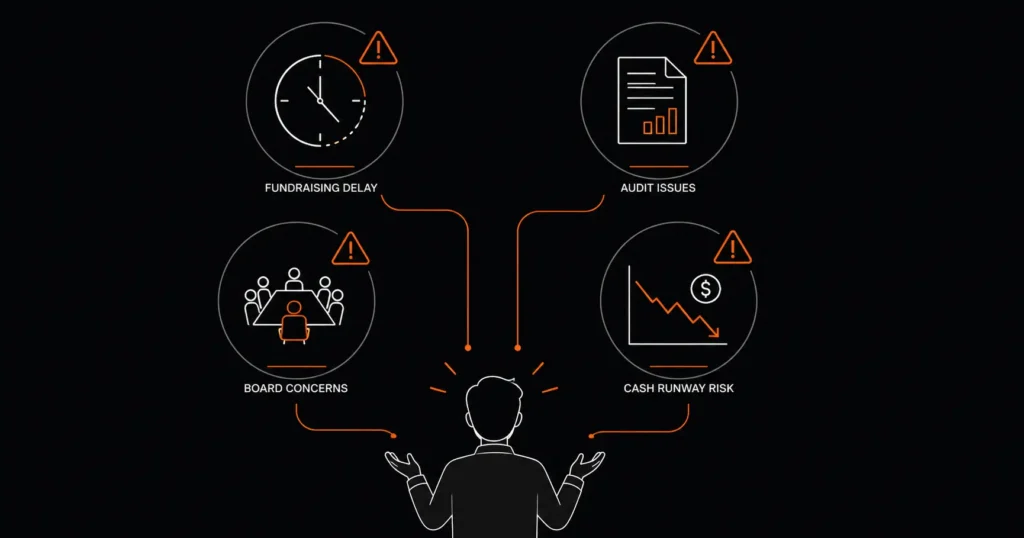
- Fundraising takes two to four months longer than it should. You’re rebuilding the financial model and data room after the term sheet arrives. That time costs you — in distraction, in dilution risk, in operational decisions you deferred while the round dragged.
- Accounting errors become audit findings. Mistakes that I would have caught and corrected mid-year become formal findings — or restatements — when nobody with CFO-level judgment has been reviewing the numbers. Restatements are never a good conversation with your board.
- Your board loses confidence. Institutional board members who consistently get late, incomplete, or confusing board packages start to lose faith in the management team. That confidence doesn’t come back easily. I’ve watched it happen.
- Cash surprises you. Without a rolling cash forecast, you find out about a cash problem when it’s already a crisis. Surprises are expensive — in the financing terms available under pressure, and in the decisions you’re forced to make instead of choosing to make.
Explore Adea's Finance Services
Frequently Asked Questions
At what revenue stage does a company need a fractional CFO?
In my experience, $3M–$7M is where most companies first need it. Below that, your bookkeeper and CPA firm can usually handle it; above $7M, not having a CFO is a material risk. Regulated industries and institutional investors can push that threshold lower — the complexity shows up earlier.
How far in advance of a fundraise should I bring in a fractional CFO?
Six months minimum — twelve if your financial infrastructure isn't investor-grade yet. The model, the data room, the reporting package take real time to build correctly. If you're building them after a term sheet arrives, you're already behind.
Do seed-stage startups need a fractional CFO?
Most don't need ongoing support at seed — the complexity usually doesn't justify it yet. But specific events do: closing an institutional round, structuring a SAFE, or preparing for an early audit. And if you have investors with board seats, early reporting discipline is one of the highest-ROI investments you can make before Series A.
Is a fractional CFO right for a bootstrapped company?
Absolutely. Cash visibility, margin analysis, and operational clarity matter whether you have a VC board or not — if anything, they matter more without one. You're the only decision-maker relying on those numbers, and there's no investor in the room catching what you're missing.